
Mid-Century Materials
A Focus on Hardwoods
Wood furniture comes with quite a variation in quality. So the question is: what makes up a quality wood furniture piece? What is it that one should look for to help them determine the quality of the furniture? The devil is in the details, so let’s take a look.
Construction Quality
This is where you can get sideways with furniture. Here are a couple of things to keep in mind. Look at the joints on the furniture piece. You do not want to see nails holding the joints together. If you see dovetail or box joints holding things together then this starts the signs of a quality piece.
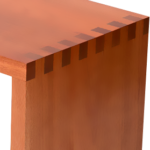
Box Joint
This type of construction is called “joinery”. You may not be able to see all the joinery. If the piece is being built by a woodworker, ask to see progress pictures of the joinery used in the construction of the furniture being built for you. Some of the quality joinery is many times hidden from view.
Common Categories
Wooden furniture falls, generally, into three varieties: composites, veneers, and of course, solid wood. Solid wood is the elite choice. It is usually more expensive, looks great, and holds up over time if made correctly (more on this later). It can usually take more abuse, without falling apart like some of the manufactured pieces from some of the well known suppliers.
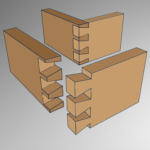
Dovetail joint
Veneers have an inexpensive wood base covered by several thin layers of better-quality wood. Because of the cheaper core, veneers aren’t as expensive as solid wood pieces. Composites (like particle board) are made from a combination of wood resin, plastics, and pulp, basically the scraps of the furniture world. These are the cheapest types of wood furniture and can look decent (in the short run), but won’t hold up over time.
Best Of The Hardwoods
And then there is the wood itself. You want your quality furniture built from one of the major hardwoods. Some the more common woods of the mid century era are Oak, Teak, Rosewood, and Beech.
Oak is the most readily available and is very hard. There are two varieties of oak, namely red and white. White oak has a grey-brown finish, whereas red has, unsurprisingly, a red hue. Both types will darken over time, a process that is accelerated with constant use.
Teak was used extensively during the mid century era. It has a brown finish, is very heavy and can range in color from golden to dark brown. Teak exudes natural oils, making it an excellent for not only indoor furniture, but it weathers well outside!
Rosewood gets its name from the fragrant smell that is released when the wood is cut. Certain types of rosewood furniture maintain this fragrance for years, giving it an unmistakable charm.
Beech is more prevalent in the mid century modern discipline. It may be that Beech is more affordable than some of the others mentioned here so we see more of it. It is used as a veneer in some of the furniture stores (aka Ikea). As a solid wood it is also high quality. Beech tends to be lighter in color, though its heartwood can exhibit a red hue.

Mid Century Materials
A Focus on Hardwoods
Wood furniture comes with quite a variation in quality. So the question is: what makes up a quality wood furniture piece? What is it that one should look for to help them determine the quality of the furniture? The devil is in the details, so let’s take a look.
Construction Quality
This is where you can get sideways with furniture. Here are a couple of things to keep in mind. Look at the joints on the furniture piece. You do not want to see nails holding the joints together. If you see dovetail or box joints holding things together then this starts the signs of a quality piece. This type of construction is called “joinery”. You may not be able to see all the joinery. If the piece is being built by a woodworker, ask to see progress pictures of the joinery used in the construction of the furniture being built for you. Some of the quality joinery is many times hidden from view.
Common Categories Of Wood
Wooden furniture falls, generally, into three varieties: composites, veneers, and of course, solid wood. Solid wood is the elite choice. It is usually more expensive, looks great, and holds up over time if made correctly (more on this later). It can usually take more abuse, without falling apart like some of the manufactured pieces from some of the well known suppliers.
Best Of The Hardwoods
And then there is the wood itself. You want your quality furniture built from one of the major hardwoods. Some the more common woods of the mid century era are Oak, Teak, Rosewood, and Beech.
Oak is the most readily available and is very hard. There are two varieties of oak, namely red and white. White oak has a grey-brown finish, whereas red has, unsurprisingly, a red hue. Both types will darken over time, a process that is accelerated with constant use.
Teak was used extensively during the mid century era. It has a brown finish, is very heavy and can range in color from golden to dark brown. Teak exudes natural oils, making it an excellent for not only indoor furniture, but it weathers well outside!
Rosewood gets its name from the fragrant smell that is released when the wood is cut. Certain types of rosewood furniture maintain this fragrance for years, giving it an unmistakable charm.
Beech is more prevalent in the mid century modern discipline. It may be that Beech is more affordable than some of the others mentioned here so we see more of it. It is used as a veneer in some of the furniture stores (aka Ikea). As a solid wood it is also high quality. Beech tends to be lighter in color, though its heartwood can exhibit a red hue.